
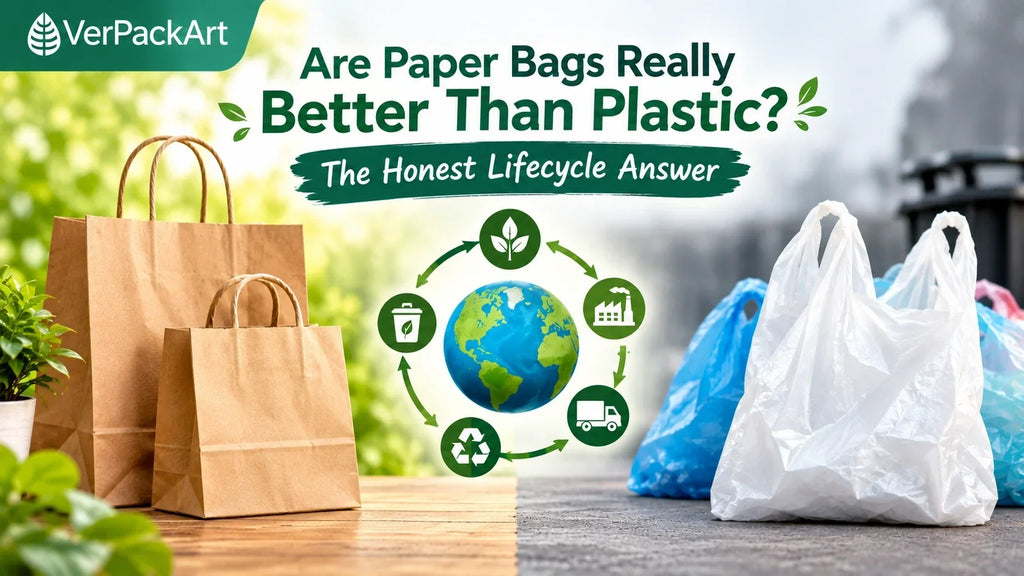
Are Paper Bags Really Better Than Plastic? The Honest Lifecycle Answer
Are Paper Bags Really Better Than Plastic? The Honest Lifecycle Answer
Are paper bags better than plastic? Looking at the full lifecycle, one can say, yes, for retail purposes, paper is the more environmentally responsible choice. Although we aren't selling you the whole story: in fact, plastic has the upper hand on one or two points and, in a true sense, the answer all depends on bag making, reusing and disposal methods. This article discusses lifecycle facts without greenwashing.
Quick Verdict — Why Paper Comes Out Ahead

When you look at the paper vs. plastic bag environmental impact, the main difference lies in the way they end up after their lives. In this aspect, paper bags come out as winners.
|
Factor |
Paper bag |
Plastic bag |
|
Recyclability |
Widely recycled |
Rarely recycled |
|
Biodegradability |
Weeks tomonths |
Up to 1,000 years |
|
Microplastic risk |
None |
High |
|
Renewable material |
Yes (wood pulp) |
No (fossil-based) |
|
Ocean & wildlife safety |
Low risk |
High risk |
|
Production energy |
Higher |
Lower |
Paper bags have one clear drawback - energy use during production, but that is only that. They are otherwise the best option for the environment.
What the Lifecycle Assessment Really Shows
A life cycle assessment evaluates the impact of a product from its material source to its production, transportation, and disposal, basically, from the cradle to the grave. It is important here to be factual about the data. The well-documented UK Environment Agency life cycle assessment (paper bag compared to a plastic bag) showed that plastic bags require fewer resources and energy to produce. That is the part plastic defenders tend to quote.
Yet, manufacturing is just one part of the story. The real issue with plastic is its disposal. For example, a single plastic bag can remain in a landfill for hundreds of years, break into microplastics, and block rivers and aquatic ecosystems. But paper is a renewable resource; it can be recycled in standard recycling systems, and it can also be composted. Considering the full lifecycle - not just the production stage - paper's advantages for end-of-life are very significant.
How Many Times Do You Need to Reuse a Paper Bag?
How many times should you reuse paper bag? The Environment Agency life cycle assessment estimates about three times to really balance out the environment impact of getting a single-use plastic bag. It is a reachable, simple goal.
A good kraft paper bag can last for quite a few shopping episodes which means that reaching break-even comes naturally during everyday usage. (As a case in point, if you keep using a cotton tote bag, you have to do it over 100 times, which means "reusable" does not equal "environmentally friendly" without additional efforts. Paper with high strength has a much shorter time-to-breaking point.)
Are Paper Bags Actually Better for the Environment?

Are paper bags really good for the environment? The answer is "yes", provided they get reused and recycled, which almost all paper bags do. Their ecological merits pile up:
Renewable and FSC-certified if they come from responsible sources
Recyclable alongside regular household paper
Biodegradable in a few weeks, not in over a century.
No microplastics and no harm to the ocean or wildlife.
A high-end, natural appearance that improves brand perception.
One honest downside is the production energy, but responsible sourcing and recycling can soon fill that gap. And that's not all; in fact, there's a much bigger movement: the EU Single-Use Plastics Directive and the German packaging guidelines are gradually removing retailers from plastics. Going for paper is not just a moral decision now, but also planning your business for future regulations!
Why Retailers and Brands Are Switching to Paper
Retailers throughout Europe are making the switch to paper for reasons that protect not only the planet but also their profits: compliance with stricter EU and German packaging regulations, highlighting better sustainability, and gaining customer trust as a result.
Paper gives a luxury carry and unboxing feeling and a printable surface that transforms each bag into brand advertising. In a market where customers evaluate brands through their packaging, paper delivers the perfect message.
The Honest Takeaway
So are paper bags better than plastic? The honest lifecycle answer is for retail packaging a few times reused paper - recycle paper you can still reuse is a responsibly, future-ready choice. Also, it is a type of renewable packaging which can not only be recycled but also decomposes naturally.
Once you have decided to make the change, VerPackArt produces tough and reusable brown kraft paper bags - with twisted handles, flat handles, or cross bottom styles - for retailers and wholesalers in Europe. Take a look at our range of paper bags and protect your brand with it.
Frequently asked questions
1. Are paper bags biodegradable?
Yes, most paper bags can decompose naturally in a couple of weeks, provided that the conditions are right. This is in stark contrast with plastics, which can lie around for centuries.
2. Are paper bags recyclable?
Yes, clean and dry paper bags can be recycled through regular household paper streams. In fact, a majority of them are manufactured by reusing old paper materials.
3. Are paper bags durable enough for heavy items?
Absolutely. Today's kraft paper bags are manufactured to support heavy burdens, with strengthened twisted-handle models that can carry groceries and shop items effortlessly.
4. How can companies buy paper bags in bulk?
You can contact VerPackArt to get wholesale paper bags for Europe delivery. Look at our range to find out what the options are in bulk retail and shipping.
Related post
17
Oct
12
Oct
06
Oct
29
Sep
RECENT POSTS
17.October.2026
Christmas Packaging Ideas for Small Businesses: Paper Bags, Gift Packaging & Bulk Buying Tips
0 Comments
12.October.2026
Wholesale Paper Bags: Prices, Minimum Order Quantities, and How to Choose a Supplier
0 Comments
06.October.2026
What Is the Best Packaging for Small Businesses? 10 Cost-Effective Options Compared
0 Comments
29.September.2026
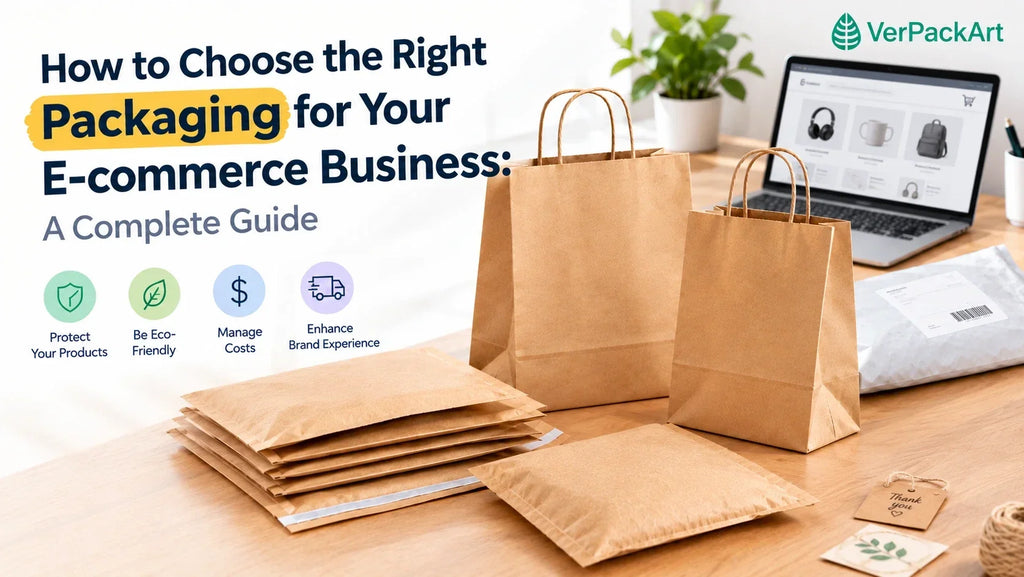
How to Choose the Right Packaging for Your E-commerce Business: A Complete Guide
0 Comments


